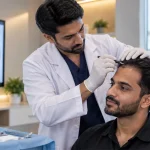
If you are noticing a thinning crown, balding, or increasing scalp visibility, you may have already started wondering whether a hair transplant is the right solution for you. But having hair loss does not automatically mean you need a transplant.
A Hair Transplant Candidate is evaluated on several factors, including the cause and pattern of hair loss, available donor hair, scalp health, age, medical history, and expectations. Knowing about these before you make an appointment for a procedure can help you decide if a transplant is really the right decision for you. Learn more about hair transplantation and the treatment options available at Medlounges.
What Makes Someone a Good Hair Transplant Candidate?
There is no single age, hair count, or level of baldness that automatically makes someone suitable for transplantation. A doctor evaluates whether enough healthy hair follicles are available in the donor region to provide meaningful coverage in the areas affected by hair loss. The assessment also considers whether the existing hair loss pattern is sufficiently established to plan where the grafts should be placed.
For many patients, the most important question is not simply whether hair is missing, but whether the available donor hair can support the desired restoration.
Does the Cause of Hair Loss Matter?
Yes. Identifying the cause is an important part of determining hair transplant eligibility.
Androgenetic alopecia (pattern hair loss) is one of the conditions for which hair transplantation may be considered. But abrupt or unexplained hair loss can be caused by a variety of factors, including health issues, nutritional deficiencies, hormonal changes, or inflammatory scalp conditions.
If the underlying cause has not been established, a doctor may recommend further evaluation before considering surgery.
Why Is Donor Hair So Important?
A hair transplant does not create new follicles. It redistributes existing follicles from a donor area to areas where hair density has decreased.
The back and sides of the scalp are commonly used as donor areas because follicles in these regions are generally more resistant to androgen-related hair loss.
The doctor assesses donor density, hair thickness, follicular characteristics, and the amount of scalp available for harvesting. Someone with extensive hair loss but limited donor density may therefore have fewer restoration options.
The amount of donor hair available also influences how many grafts can realistically be used. Understanding how many grafts you need for a hair transplant can help explain why the same number of grafts may not be suitable for every patient.
Is There an Ideal Age for a Hair Transplant?
Age is only one part of the assessment. Younger patients may still be experiencing active hair loss, making it difficult to predict how the hairline or crown will look several years after transplantation. In some cases, treating the ongoing hair loss medically before considering surgery may be more appropriate.
Older patients are not automatically excluded either. If they have adequate donor hair, suitable scalp health, and realistic expectations, transplantation may still be considered.
The important question is whether the pattern of hair loss can be planned responsibly over the long term.
Can Women Get Hair Transplants?
Yes. Women can undergo hair transplantation when the cause and pattern of hair loss make them suitable candidates.
However, female hair loss can have several underlying causes, and diffuse thinning may require a different approach from the typical male-pattern presentation.
A medical evaluation is therefore particularly important before surgery to understand the distribution of thinning and determine whether sufficient donor follicles are available.
What Does the Doctor Check Before Surgery?
A detailed consultation and scalp examination are carried out to determine the suitable candidate for a hair transplant.
The doctor will see:
- Pattern and extent of hair loss
- Donor region densities
- Hair shaft features
- Condition of the scalp
- Previous hair loss treatments
- History of the present illness and medications
- Future hair loss prediction
- What patients expect and want covered
A Hair Transplant Candidate is evaluated on several factors, including the cause and pattern of hair loss, available donor hair, scalp health, age, medical history, and expectations.
A medical assessment is important before deciding on transplantation because the cause and pattern of hair loss can affect whether a transplant is appropriate. The NHS guide to hair transplants also recommends discussing the surgeon’s qualifications, experience, recommended procedure and follow-up care before treatment.
Does Hair Density Affect Candidacy?
Yes. Hair density directly influences how much coverage can realistically be achieved.
Patients with good donor density may have greater flexibility when planning the hairline, crown, or other thinning areas. When donor density is limited, the doctor may need to prioritise specific areas rather than attempting to cover the entire scalp.
This is why promising a particular number of grafts before assessing the scalp is not an appropriate way to determine candidacy.
Can Someone With Advanced Baldness Get a Hair Transplant?
Some patients with advanced hair loss may still qualify, but the available donor supply becomes particularly important.
The more bald space, the more grafts it takes to make it look covered. If the donor area doesn’t have enough follicles, the doctor may suggest focusing on the frontal hairline and mid-scalp instead of trying for full coverage.
The objective should be to use the available donor follicles strategically rather than exhaust them during a single procedure.
What About Medical Treatment Before a Hair Transplant?
Some patients may benefit from medical management before or alongside transplantation. This may be especially relevant if hair loss is still ongoing. The first transitional phase is to control existing hair loss. This can help preserve all or some of the existing hair while waiting for the transplanted follicles to become part of the overall look. Patients should also understand that transplanted hair does not appear immediately; the hair growth timeline after a hair transplant can vary during the healing and growth phases.
This may be especially relevant if hair loss is still ongoing. The first transitional phase is to control existing hair loss. This can help preserve all or some of the existing hair while waiting for the transplanted follicles to become part of the overall look.
The appropriate treatment depends on the diagnosis, medical history, and individual circumstances and should be discussed with a qualified doctor.
What Expectations Should a Candidate Have?
Realistic expectations are one of the most important hair transplant requirements.
A transplant can improve hair coverage and density in selected areas, but it cannot necessarily recreate the hair density someone had in their early adulthood.
The final result also takes time. Transplanted follicles undergo a growth cycle, and visible improvement develops gradually rather than immediately after surgery.
A good candidate understands both what transplantation can achieve and what it cannot.
When Might a Hair Transplant Not Be Recommended?
A doctor may postpone or avoid transplantation when the cause of hair loss is unclear, the scalp has an untreated condition, donor hair is insufficient, or expectations are unrealistic.
Patients experiencing rapidly progressive hair loss may also need their condition stabilised before surgical planning.
In these situations, saying that someone is not currently suitable does not necessarily mean transplantation will never be possible. It may simply mean that another medical step should come first.
Expert Insights
At Medlounges, we evaluate a Hair Transplant Candidate based on the clinical appropriateness of transplantation for the pattern of hair loss, supply of donor hair, and long-term goals of the individual.
The consultation is used to explain realistic coverage, available treatment options, expected recovery, and the limitations of transplantation before a patient makes a decision.
Patients should understand the expected healing process before making a decision. Our guide to the hair transplant recovery timeline explains what patients may experience after the procedure.
Frequently Asked Questions
Who can get a hair transplant?
The right candidates for transplantation are those with the right patterns of permanent hair loss, adequate donor hair and realistic expectations. *Final suitability to be determined by the individual.
For patients considering FUE, it may also be useful to understand how the procedure is performed and who it may suit. Read FUE hair transplant in Kerala: how the procedure works and who it may suit for more information.
What are the main hair transplant requirements?
Factors that are important include having enough donor hair, a healthy scalp, the right cause and pattern of hair loss, and having realistic expectations about coverage and results.
Can someone with a receding hairline get a transplant?
Yes. A receding hairline can be treated in selected patients when sufficient donor follicles are available, and the future pattern of hair loss can be reasonably planned.
Can women undergo hair transplantation?
Yes. Women may be suitable candidates depending on the cause and distribution of hair loss and the availability of suitable donor follicles.
Is there a minimum age for a hair transplant?
There is no single age that applies to every patient. Doctors consider whether hair loss is stable enough to allow responsible long-term planning.
What happens if I do not have enough donor hair?
The doctor may recommend prioritising specific areas or exploring medical and other treatment options. The available donor supply determines how much transplantation can realistically be achieved.
Conclusion
For being a Hair Transplant Candidate is not determined by the amount of hair you have lost alone. Hair-loss pattern, scalp health, age, medical history, and expectations all influence whether transplantation is appropriate.
Understanding your hair transplant eligibility through a proper medical assessment is therefore more useful than comparing yourself with someone else’s transplant result.
The First Step to Your Consultation
If you are unsure whether you are suitable for transplantation, a consultation can help you understand your current hair-loss pattern, donor availability, and realistic treatment options.
Ready to understand your options? Book your consultation at Medlounges, Kochi / Thiruvalla today.
Medical Disclaimer: This article is for informational purposes only and does not constitute medical advice. Readers should consult a qualified dermatologist, plastic surgeon, or appropriately trained medical professional before undergoing hair transplantation.