Pigmentation that won’t go away. Acne marks last longer than any serum. Tanning that doesn’t go away and stays unevenly. A lot of people with Indian or brown skin have these worries, and a lot of them are afraid of treatments that might make things worse. The good news is that Indian skin reacts very well to chemical peels when the right one is used. A dermatologist will decide what the best chemical peel for Indian skin based on your Fitzpatrick skin type, your diagnosed problem and your treatment history.
What Is a Chemical Peel?
A chemical peel is a procedure carried out by the Department of Dermatology. The clinician will apply a chemical solution to the skin causing the outermost layer of skin to be exfoliated in a controlled manner. If you’re exploring advanced skin treatments, you can also check our all expert cosmetics treatment services. There are three types of chemical peels: superficial, medium depth, and deep, each of which uses different types of peeling agents, penetrates at different levels and requires various recovery times. The first critical step to using a chemical peel on a person, especially with Indian skin, is determining the appropriate depth of the chemical peel.
Why Indian Skin Requires Special Consideration?
Indian skin falls under Xn types III to V. The Fitzpatrick scale categorises the various types of skin depending on their reaction to UV light. Indian skin pigment has more melanin than skin types I and II and as a result reacts similarly to injury or inflammation by producing excess pigment (hyperpigmentation). The use of a chemical peel that is safe for Indian skin must be determined through clinical evaluation rather than by polling the masses.
The greatest risk posed by improperly administering any type of chemical peel to a dark skinned individual in India, is developing post-inflammatory hyperpigmentation (PIH), a dermatological condition in which trauma to the skin triggers excessive activity of the melanocytes. Prior to determining which chemical agent and concentration to use for a chemical peel, dermatologists evaluate the skin type based on the Fitzpatrick classification system.
“The most common mistake with chemical peels in Indian skin is choosing too deep a peel, too soon — and paying for it with months of post-inflammatory darkening.”
Types of Chemical Peels: Superficial, Medium, and Deep
The outermost layer of skin is the target of a superficial peel. Glycolic acid (20–35%), salicylic acid, and lactic acid are all examples of agents. Very little time off. The safest way for people with brown skin to get in and a dermatologist-recommended peel for people who have never had one before.
The medium-depth peel goes into the papillary dermis. Agents consist of TCA (trichloroacetic acid, 20–35%) or combination formulations. Good for moderate pigmentation and acne scars on prepared Indian skin that is being closely watched by a doctor.
Deep Peel—Use with Caution: It goes deep into the reticular dermis with phenol-based agents. There is a high risk of permanent pigment changes and scarring for people with darker skin who get a deep peel. Not often recommended for Indian skin types IV and V.
Choosing by Concern: Pigmentation, Acne, Tanning, and Sensitivity
| Skin Concern | Recommended Peel Agent | Depth |
| Acne & oily skin | Salicylic acid (20–30%) | Superficial |
| Pigmentation & melasma | Glycolic acid, mandelic acid, kojic acid | Superficial–Medium |
| Tanning & uneven tone | Lactic acid, azelaic acid | Superficial |
| Sensitive & reactive skin | Lactic acid peel (low concentration) | Superficial |
| Mild–moderate acne scarring | TCA 15–25%, glycolic acid combination | Superficial–Medium |
Salicylic acid dissolves in oil and gets into sebaceous follicles, which is why it is the best chemical peel for Indian skin with acne. Mandelic acid and lactic acid penetrate more slowly and carry a lower PIH risk in Fitzpatrick types IV and V.
How a Dermatologist Selects the Right Peel?
A dermatologist does a formal skin exam, which includes figuring out the Fitzpatrick skin type, diagnosing the main problem, going over the patient’s medication history, and doing a patch test if necessary.
The IADVL suggests a conservative, stepped approach, starting with a lower concentration and increasing it over sessions based on how the skin reacts, instead of starting with a high concentration.
The Procedure
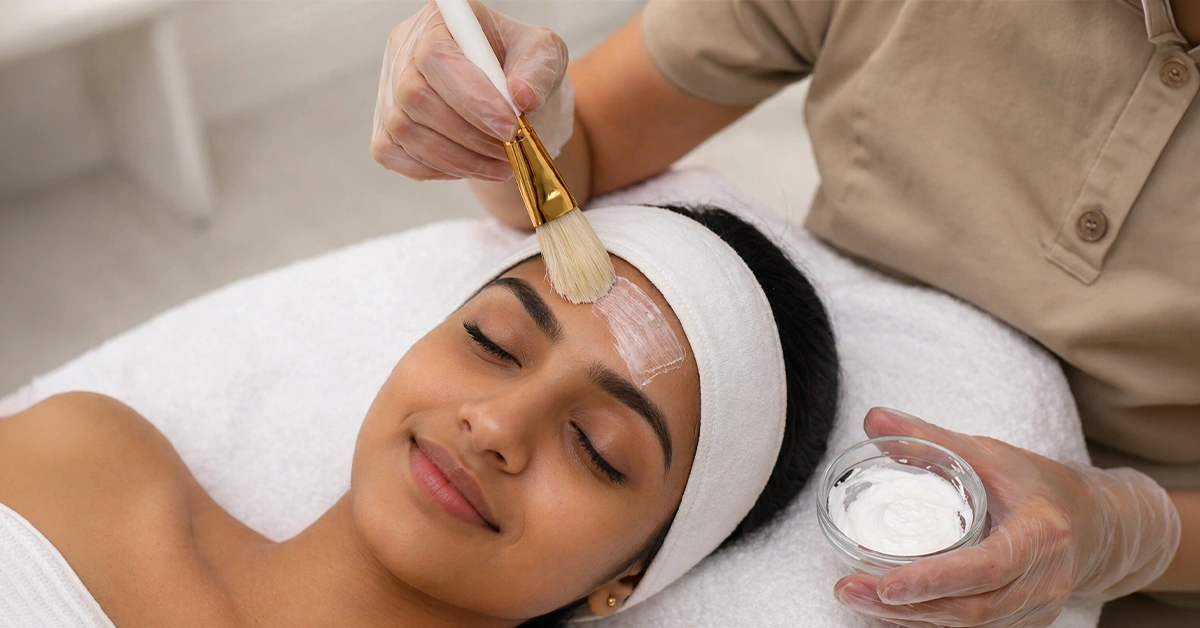
Before a peel session, the skin is cleaned very well. The chosen peeling agent is put on evenly, left on for a set amount of time based on the acid concentration and how the patient’s skin reacts, and then neutralized or taken off. The NHS says that only trained professionals in a clinical setting should do chemical peels, especially for people with darker skin tones because the margin for error is smaller. Most of the time, sessions last between 20 and 45 minutes.
Benefits for Indian Skin
-
- Controlled epidermal turnover helps to fade hyperpigmentation and post-acne marks.
-
- Fixes skin that is uneven in color because of tanning, melasma, or sun damage
-
- Clears out pores and makes acne less severe, especially when used with salicylic acid.
-
- Over the course of treatment, it makes the skin feel better and boosts collagen production.
For holistic skin health, you can also consider Ayurveda wellness therapies
Risks and Precautions for Darker Skin Tones
The main risk of any chemical peel on Indian skin is post-inflammatory hyperpigmentation. This happens when skin damage makes melanocytes work too hard, which causes dark spots to appear where the treatment was done. This risk is greater with more powerful peels, not enough patch testing, or bad sun protection after the procedure.
The ICMR says that all elective dermatological procedures should only be done in accredited clinical settings. Fitzpatrick types IV and V should not use peels that they do themselves at home.
Post-Treatment Care
Post-Peel Protocol for Indian Skin:
-
- You must use broad-spectrum sunscreen with an SPF of 30 or higher every morning for at least four weeks after the procedure.
-
- Don’t let the sun hit your skin directly for at least 48 hours after the peel.
-
- For 48 to 72 hours, only use moisturizers that are gentle and don’t have any active ingredients like retinol or AHAs.
-
- Don’t pick at or pull off peeling skin; this greatly raises the risk of PIH.
Explore professional skincare guidance at Medlounges dermatology care
Before and After: What You Should Expect from Indian Skin
People who are looking at the results of a chemical peel on Indian skin should know that the results will get better over time. A single superficial peel can brighten the skin slightly, but to see a significant difference in pigmentation, you usually need four to six sessions spaced two to four weeks apart.
Ideal Candidates
A suitable candidate presents with localised pigmentation, acne-related concerns, mild textural irregularity, or tanning — with no active skin infection, open wounds, or recent isotretinoin use. If you are pregnant or breastfeeding you should also avoid chemical peels.
Alternatives to Chemical Peels
If chemical peels are not right for you there are options. You can try microneedling or laser toning. You can also use creams to help with pigmentation.
Conclusion
Selecting the best chemical peel for Indian skin is not a decision that should be made based on trends, at-home kits, or generic advice. Indian skin — with its higher melanin content and greater susceptibility to post-inflammatory hyperpigmentation — requires a dermatologist-led assessment, Fitzpatrick skin typing, and a conservative, stepped treatment approach aligned with clinical guidelines from bodies such as the IADVL and ICMR.
A safe chemical peel for Indian skin is one chosen specifically for your concern, applied at the correct concentration, and supported by daily sun protection. Done correctly, a series of peels can meaningfully reduce pigmentation, acne marks, and uneven tone.
Ready to find out which chemical peel is right for your skin? Book a consultation
Medical Disclaimer: This article is intended for informational purposes only and does not constitute medical advice. All clinical information is based on guidelines from the ICMR, IADVL, NHS, and WHO. Readers are strongly advised to consult a qualified dermatologist before undergoing any chemical peel procedure
Frequently Asked Questions
Which chemical peel is best for Indian skin?
The best chemical peel for Indian skin depends on your skin type, concern, and treatment history. Superficial peels such as lactic, glycolic, mandelic, or salicylic acid may be considered for selected concerns, while deeper peels require greater caution because darker skin can be more prone to pigmentation changes.
- Salicylic acid is commonly used for acne-prone skin.
- Lactic or mandelic acid may suit sensitive or darker skin.
- A dermatologist should determine the appropriate concentration and depth.
Are chemical peels safe for Indian skin?
Chemical peels can be safe for Indian skin when the appropriate peel, concentration, and treatment depth are selected professionally. Because Indian skin can have a higher risk of post-inflammatory hyperpigmentation, treatment should be tailored to the individual rather than chosen solely from online recommendations or home-peel products.
- Fitzpatrick skin typing helps guide treatment selection.
- Superficial peels are generally approached more conservatively.
- Professional assessment reduces the risk of inappropriate treatment.
Can chemical peels reduce pigmentation and acne marks?
Chemical peels can help reduce pigmentation and post-acne marks by promoting controlled exfoliation and skin renewal. The most suitable peeling agent depends on the type and severity of pigmentation, your skin tone, and previous treatments. A series of treatments may be needed rather than expecting complete improvement after one session.
- Glycolic, mandelic, and kojic-based approaches may be considered for pigmentation.
- Salicylic acid is commonly used for acne-prone skin.
- Four to six sessions may be recommended for some pigmentation concerns.
Can a chemical peel make Indian skin darker?
An incorrectly selected or aggressively applied chemical peel can cause post-inflammatory hyperpigmentation, which may temporarily darken treated skin. This risk is particularly important for Fitzpatrick skin types IV and V. Appropriate peel selection, professional application, patch testing when indicated, and consistent sun protection can help reduce the risk.
- Avoid picking or peeling treated skin during recovery.
- Use broad-spectrum sunscreen with SPF 30 or higher.
- Stronger or deeper peels require greater caution in darker skin.
How many chemical peel sessions are needed for pigmentation?
Pigmentation often requires a series of chemical peel sessions rather than a single treatment. For some cases involving Indian skin, four to six superficial sessions may be recommended, with approximately two to four weeks between treatments. The dermatologist adjusts the treatment plan according to pigmentation severity and the skin’s response.
- Treatment intervals commonly range from two to four weeks.
- Results usually develop progressively.
- Stronger treatment is not necessarily better for pigmentation.