Most people begin at the pharmacy. A cream that promises results, a patch that is supposed to work overnight, or a home remedy someone swore by online. You try it for weeks. The wart looks identical. Sometimes it looks worse. So you try something else, and then something else again, and months later, you are still dealing with the same stubborn growth, but with considerably less patience.
This is one of the more quietly frustrating skin concerns people deal with, mainly because it seems simple to fix. The reality is that many warts, especially those that have been there for a while, don’t react to over-the-counter remedies. They require a different level of intervention.
In this article, we will tell you what warts really are, why home treatments often don’t work, what wart cauterization treatment is, and what to realistically expect from the process — so that you can make an informed decision rather than an expensive guess.
What Warts Really Are
Warts are harmless skin growths caused by strains of the human papillomavirus — commonly known as HPV. The virus infects the outer layer of the skin, causing cells to multiply faster than normal and creating the raised, rough-textured growth most people have seen.
They are transmitted by direct contact, either with another person or with contaminated surfaces, and they enter the skin most easily through small cuts or breaks. Not everyone who is exposed to the virus gets a wart, because the immune response is a major factor in whether it takes hold.
Warts are medically harmless for the most part. But harmless does not mean insignificant – especially if they are persistent, visible, or in locations prone to friction and irritation.
Why Home Remedies Don’t Work
Over-the-counter treatments, such as salicylic acid, can be effective for small, superficial warts when used consistently. The problem is that most people aren’t dealing with a small, superficial wart by the time they start researching clinical options.
Warts that have been there for months tend to be more deeply embedded in the skin. They’ve had time to thicken, spread, or develop a texture that surface-level treatments can’t penetrate effectively. The cream works on the outside, but the problem is no longer entirely gone.
Medical attention becomes especially important when:
- Warts keep growing even though you are treating them at home regularly
- The lesion becomes painful, bleeds, or changes in appearance.
- Warts spreading to the surrounding skin or new sites
- The growth is a cosmetic concern and on the face, neck, or other visible site
- The wart is in an area subject to friction or repeated irritation
In these cases, dermatology wart treatments are not an overreaction. It is the next appropriate clinical step.
What Wart Cauterization Is
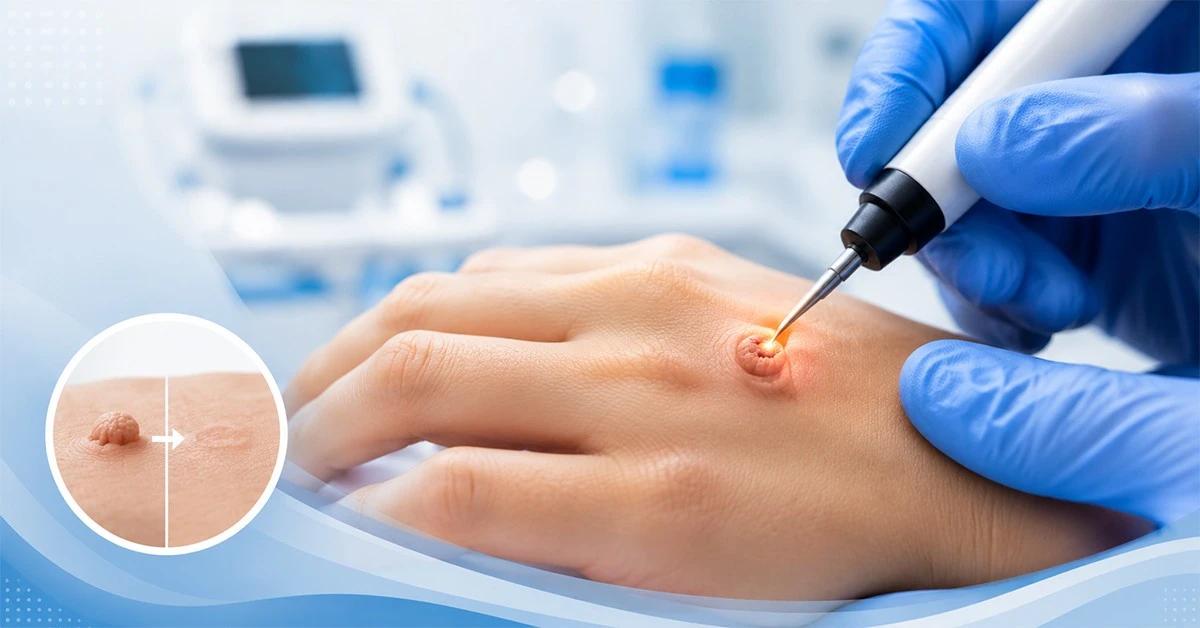
Wart cauterization is one of the most commonly used and clinically reliable methods for removing stubborn or persistent warts. The procedure utilises controlled heat or electrical energy — administered via a specialised device — to accurately destroy the targeted wart tissue while minimising impact on the surrounding skin.
A local anaesthetic is used before the procedure begins to make it as comfortable as possible. The majority of patients feel very little during the treatment – a bit of pressure or warmth at most. The actual removal is rapid, usually a few minutes per lesion.
Read More: What Is Exosome Therapy for Skin? How It Works & Benefits Explained
The wart-removal procedure is deliberately precise. The dermatologist aims specifically at the wart tissue, taking care to work around healthy skin to achieve a clean result. For wart cauterization for stubborn warts—those that have not responded to topical treatments or have recurred after previous attempts—this level of precision makes a meaningful clinical difference.
Recovery and What to Expect Next
Post-treatment, the area will generally be red and mildly tender. It is totally normal. Over the next few days, a little scab will form, and the skin will start the natural healing process.
Most patients return to their normal daily activities immediately or within a day, depending on the size and location of the treated wart. Aftercare is simple:
- Initially, keep the area clean and dry
- Don’t pick or disturb the scab that forms over the treated area
- Apply any prescribed topical ointment as directed by your doctor.
- Apply sun protection to treated areas, especially on the face or neck.
Skin renewal following wart removal takes time but is evident. Most patients are pleasantly surprised by how clean and smooth the area looks as the scab falls away naturally and new skin forms underneath. Clear skin treatment results vary based on wart size, location, and how well aftercare instructions are followed. Still, the vast majority of patients heal well with minimal visible alteration to the surrounding skin.
Also Read: Top Benefits of Laser Skin Rejuvenation Treatments for Glowing Skin
Scarring, Safety, and Realistic Expectations
One of the most frequently asked questions before proceeding is whether cauterization leaves a scar. The honest answer is that there is always a small chance of temporary post-procedure marks, especially for bigger or deeper warts. But when performed by an experienced dermatologist with the right technique, noticeable scarring is rare and tends to fade significantly over time.
Removing skin growths by cauterization does not guarantee that warts will never return. As the underlying virus can lie dormant in the skin, some people may have recurrences – especially those with lowered immunity or repeated exposure.
This is why the best wart removal treatment decisions are always made on a case-by-case basis — taking into account wart type, location, skin condition, and medical history — rather than applying a one-size-fits-all approach.
The Confidence and Cosmetics Dimension
It is worth openly acknowledging that for many people, the choice to seek treatment is as much about confidence as it is about clinical necessity. Visible warts on the face or neck influence how individuals feel in professional and social environments, and even in their own reflections.
Cosmetic skin procedures for wart removal are legitimate. Aesthetic skin treatments for visible skin growths are recognized and medically appropriate parts of dermatology practice. It’s reasonable to want to feel comfortable in your skin — and medically guided skin wart removal is one of the more straightforward ways to do just that.
Conclusion
Persistent warts are unlikely to clear completely by themselves – and the longer you leave them, the more entrenched they become. Understanding wart cauterization treatment and what it really involves can help patients break the cycle of ineffective home remedies and make a more informed, confident choice.
More than the removal of Dermatology wart treatment. It’s about doing it safely, doing it precisely, and taking proper care before and after — so the skin heals well and the result lasts.
Wart removal treatment at Medlounges is administered by experienced aesthetic physicians and dermatologists who evaluate each patient individually and suggest the most suitable method based on the type of wart, skin condition, and previous treatment. With the proper clinical guidance, achieving smooth, clear skin is not only possible — it is within reach.
The First Step to Your Skin Consultation
A consultation is more than an appointment. It is a chance to understand your skin concern properly, ask the questions you have been carrying, and receive genuinely tailored advice — not a standard package.
Ready to take that first step? Book your skin consultation at Medlounges, Kochi / Thiruvalla today.
Medical Disclaimer: This article is for informational purposes only and does not constitute medical advice. Readers should consult a qualified aesthetic physician or dermatologist before undergoing any cosmetic or dermatological procedure.
Frequently Asked Questions
What is the difference between HD liposuction and body contouring?
Wart cauterization is a procedure that destroys unwanted wart tissue using a controlled treatment method. It may be recommended when warts persist or do not respond adequately to other treatments, depending on their type, location, and size.
- Targets the wart tissue.
- Treatment is performed by a trained professional.
- Assessment is required before treatment.
Is wart cauterization painful?
Some discomfort may occur during or after wart cauterization. A healthcare professional may use local anaesthesia or other measures to make the procedure more comfortable depending on the wart’s location and treatment method.
- Discomfort varies by individual.
- Local anaesthesia may be considered.
- Follow aftercare instructions carefully.
How long does wart cauterization take to heal?
Healing time varies according to the wart’s size, location, treatment depth, and individual skin response. The treated area may require several days or weeks to heal completely while the skin gradually recovers.
- Keep the treated area clean.
- Avoid unnecessary irritation.
- Follow the recommended wound-care instructions.
Can warts come back after cauterization?
Yes, warts can sometimes return after treatment because the underlying viral infection may remain in the skin. Recurrence depends on the type of wart, immune response, location, and other individual factors.
- Recurrence is possible.
- Follow-up may be necessary.
- New warts can develop separately.
Is wart cauterization suitable for everyone?
Wart cauterization is not automatically suitable for every skin growth. A dermatologist should first confirm that the lesion is a wart and assess its size, location, appearance, and medical history before recommending treatment.
- Correct diagnosis is important.
- Treatment varies by wart type.
- Professional evaluation is recommended.