You exercise consistently. You watch what you eat. Yet stubborn fat on the tummy, flanks, arms, and thighs simply will not shift. For patients who have exhausted diet and lifestyle changes, liposuction for tummy, flanks, arms and thighs is the clinically validated solution and this guide explains exactly what the procedure involves, who it suits, and what to expect during recovery.
At Medlounges Kochi, our body contouring range includes standard liposuction as well as advanced techniques such as VASER liposuction, all performed by qualified surgeons with anaesthesia support.
What Is Liposuction?
Liposuction is an elective surgical procedure performed by qualified surgeons to remove localised fat deposits resistant to diet and physical activity. The American Society of Plastic Surgeons classifies it as a body contouring intervention not a weight-loss treatment.
The surgeon evaluates localised fat distribution, skin elasticity, and patient health during a pre-operative consultation. This assessment determines candidate suitability and identifies which zones require targeted body fat removal.
Also Read: HD Liposuction – The Six-Pack You’ve Worked For, Finally Visible
Areas Treated: Tummy, Flanks, Arms and Thighs
Liposuction addresses several anatomical zones, each presenting distinct fat distribution characteristics that influence the surgical approach.
Liposuction for Tummy
Liposuction for the tummy removes subcutaneous abdominal fat above and below the umbilicus that resists caloric restriction due to hormonal and genetic distribution patterns.
Liposuction for Flanks
Liposuction for flanks addresses lateral abdominal and posterior waist fat commonly called love handles which responds poorly to diet in patients with androgenic fat distribution.
Liposuction for Arms
Liposuction for arms reduces excess fat in the tricep and axillary regions of the upper arm, where localised fat accumulates particularly following hormonal changes in women.
Liposuction for Thighs
Liposuction for thighs targets inner thigh chafing and outer thigh fullness areas of gynoid fat concentration identified during pre-operative body mapping by the surgeon.
How Does It Differ from HD Liposuction?
Patients sometimes ask how standard liposuction for tummy, flanks, arms and thighs differs from HD liposuction. Standard liposuction focuses on smooth, proportionate fat reduction and improved body shape. HD liposuction goes further etching muscle contours for a high-definition, athletic result. Your surgeon will recommend the right technique based on your goals and anatomy during consultation.
Types of Liposuction Techniques
The surgical team selects the liposuction technique based on patient anatomy, fat volume, and treatment zone requirements.
| Technique | Mechanism | Clinical Application |
| Suction-Assisted (SAL) | Manual cannula with vacuum suction | Standard localised fat reduction across all zones |
| Ultrasound-Assisted (VASER) | Ultrasound energy selectively emulsifies fat | Fibrous areas; high-definition body contouring |
| Laser-Assisted (LAL) | Laser liquefies fat and stimulates collagen | Areas requiring additional skin tightening |
| Power-Assisted (PAL) | Vibrating cannula reduces manual trauma | Large-volume removal; previously treated areas |
The Liposuction Procedure
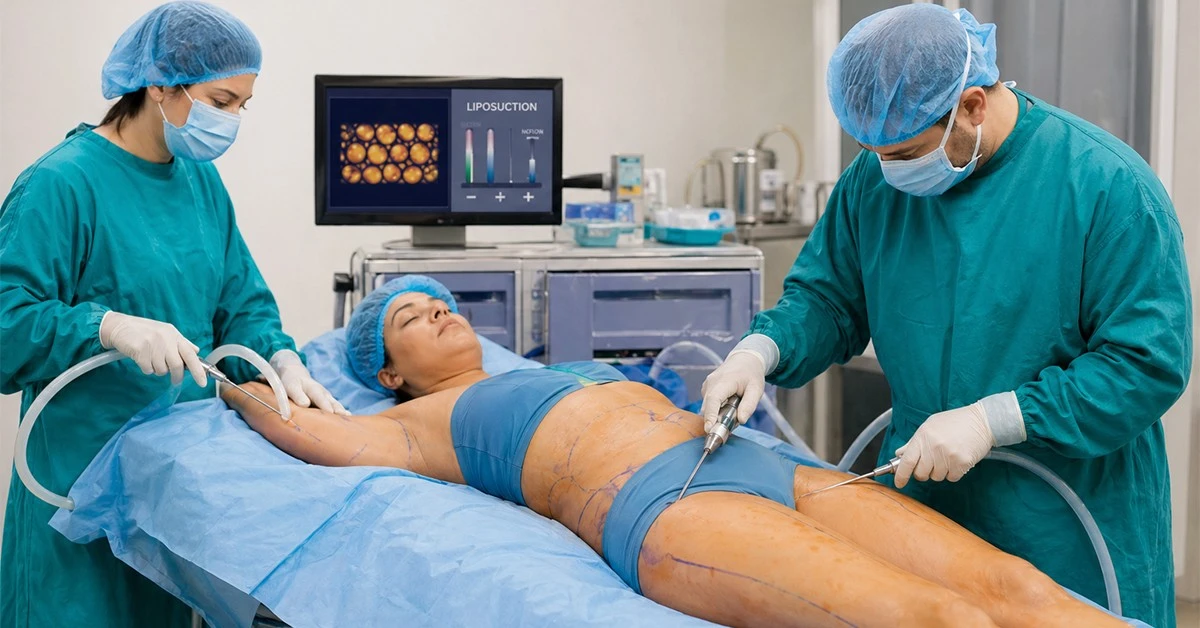
The liposuction procedure follows operative protocols consistent with NHS surgical guidelines. Pre-operatively, the surgeon performs body mapping in a standing position marking fat zones, anatomical landmarks, and planned incision sites.
A tumescent solution containing saline, adrenaline, and local anaesthetic is infused into the treatment zone to reduce bleeding and improve precision. Calibrated cannulas are then inserted through small incisions to aspirate the emulsified fat under general or local anaesthesia with sedation.
Procedure duration ranges from one to four hours, depending on the number of areas treated. Most patients are managed as outpatients and return home the same day.
Benefits of Liposuction for Tummy, Flanks, Arms and Thighs
“Liposuction is not a substitute for a healthy lifestyle it is a precise surgical tool for localised fat deposits that do not respond to conventional weight management.”
-
- Permanent removal of localised fat cells from treated zones
-
- Improved body proportion following targeted body fat removal
-
- Multiple areas tummy, flanks, arms, and thighs treatable within a single operative session
-
- Shorter recovery compared to open surgical body contouring procedures
-
- Long-lasting outcomes when maintained through stable weight and physical activity
Risks and Considerations
Liposuction should only be performed in registered hospitals by qualified surgeons, with anaesthesia support. Known risks include temporary swelling, bruising, contour unevenness, seroma formation, and infection. Proper candidate selection, pre-operative medical clearance, and post-operative compression care significantly minimise these risks.
Recovery Process
A graded clinical regimen supports recuperation. Our surgical team prescribes a compression garment for four to six weeks to minimise swelling and encourage tissue remodelling.
| Timeline | What to Expect |
| Days 1–3 | Full rest. Swelling and bruising at peak. Continuous compression garment wear. Oral pain relief prescribed. |
| Days 4–7 | Light movement resumes. Routine desk tasks manageable. Dressing review appointment. |
| Weeks 2–4 | Gradual recovery. Bruising resolves. Swelling reduces. Compression garment maintained. |
| Weeks 4–6 | Clearance for gym after surgical review. Body contour becomes visible. Skin repair treatments may be introduced with surgeon approval. |
| Months 3–6 | Final results established. Residual oedema resolves. Defined body shape confirmed. Follow-up evaluation completed. |
Before and After Results
As swelling subsides post-surgery, the results of liposuction for tummy, flanks, arms and thighs become progressively clearer. Body contour improvement is typically visible within four to six weeks, with final results assessed at three to six months. Our team maintains standardised before-and-after photography to objectively compare outcomes against pre-surgical goals.
Who Is an Ideal Candidate?
Suitable Candidates
-
- BMI within 18.5–29.9, or within 30% of ideal body weight
-
- Localised fat deposits resistant to diet and exercise
-
- Good skin elasticity with minimal laxity
-
- Non-smoker or willing to cease smoking six weeks prior
-
- Realistic expectations regarding body contouring outcomes
Currently Not Suitable If:
-
- BMI exceeds 35, or active obesity treatment is ongoing
-
- Significant skin laxity non-surgical options such as thread lifting may be explored as an alternative or complement
-
- Uncontrolled systemic conditions such as diabetes or cardiovascular disease
-
- Active dermatological condition in the treatment zone
-
- Pregnancy or planned pregnancy within 12 months
Cost of Liposuction
The cost of the procedure is determined by treatment zones, anaesthetic type, facility accreditation level, and surgeon experience. In India, localised fat reduction for a single zone typically ranges from ₹60,000 to ₹1,50,000, with multi-zone procedures priced according to operative complexity.
ICMR guidelines require transparent disclosure of all procedure-related costs including compression garments and follow-up consultations before patient consent is obtained.
Non-Surgical Alternatives
For patients who are not surgical candidates, non-invasive options for localised fat reduction include cryolipolysis, HIFU, and radiofrequency-based fat reduction. Patients looking to improve skin texture alongside or instead of surgery may benefit from our chemical peels treatments, which address surface skin quality with no downtime. Non-invasive treatments do not require anaesthesia or a recovery period; however, their results are less significant compared to surgical intervention.
Conclusion
Liposuction for tummy, flanks, arms and thighs is a clinically confirmed elective technique that delivers precise, long-lasting results when performed by a qualified surgeon at a registered hospital with anaesthesia support. It targets localised fat deposits that do not respond to traditional weight loss methods, enhancing body proportion and patient well-being when diet and exercise alone have proven inadequate.
Proper candidate selection, careful pre-operative planning, and a systematic post-operative care plan are the foundations of a safe and successful outcome. It is not a shortcut it is a well-planned clinical answer for the right patient.
Frequently Asked Questions
Is liposuction a weight-loss treatment?
Liposuction is a body-contouring procedure, not a treatment for general weight loss. It removes localised deposits of fat that may remain despite diet and exercise. The procedure is intended to improve body proportions rather than significantly reduce overall body weight, so suitable candidates are generally near a stable weight.
- Common treatment areas include the tummy, flanks, arms, and thighs.
- Stable weight helps maintain the contouring result.
- A qualified surgeon assesses your health and fat distribution before treatment.
Can tummy, arms and thighs be treated during one liposuction procedure?
Multiple areas can sometimes be treated during one liposuction procedure, provided the overall treatment remains medically appropriate. The surgeon considers the number of areas, total fat volume, anaesthesia requirements, and your general health before planning combined treatment. Safety limits always take priority over treating additional areas.
- Tummy, flanks, arms, and thighs may be addressed together.
- Preoperative body mapping helps plan treatment areas.
- Your surgeon determines whether combined treatment is appropriate.
How long does liposuction recovery take?
Liposuction recovery varies between patients, but light activity often resumes within five to seven days. Swelling and bruising gradually decrease over the following weeks, while compression garments may be recommended for four to six weeks. Final body-contouring results are generally assessed after swelling has substantially resolved.
- Days 1–3 generally involve rest and compression.
- Light daily activities may resume around days 4–7.
- Final results may become clearer over three to six months.
Are liposuction results permanent?
Liposuction results can be long-lasting because the fat cells removed during treatment do not regenerate. However, remaining fat cells can enlarge if you gain significant weight after surgery. Maintaining a stable weight through balanced nutrition and physical activity is therefore important for preserving the improved body contour.
- Removed fat cells do not grow back.
- Significant weight gain can alter the treated contour.
- Regular physical activity supports long-term results.
What areas can liposuction treat besides the tummy?
Liposuction can treat several areas where localised fat deposits are present, including the flanks, upper arms, inner thighs, and outer thighs. The specific areas selected depend on fat distribution, skin elasticity, body proportions, and the patient’s goals. A surgeon evaluates these factors before creating an individual treatment plan.
- Tummy treatment focuses on localised abdominal fat.
- Arm treatment commonly targets triceps and axillary fat.
- Thigh liposuction may address inner or outer thigh fullness.