Hair thinning and hair loss can gradually affect hair density, balding, and confidence. When medical treatments are no longer enough to restore lost density, hair transplantation may be considered for suitable candidates.
The most common treatment is FUE (Follicular Unit Extraction) hair transplant, where the follicles are individually extracted from a donor area and implanted into the areas with hair loss. For those considering an FUE Hair Transplant in Kerala, knowing how the procedure works, who it could be suitable for, and what to expect after treatment can help you make a more informed decision. Learn more about hair transplantation at Medlounges.
What Is FUE Hair Transplantation?
FUE, or Follicular Unit Extraction, is a hair transplantation technique in which individual follicular units are extracted from a donor area, usually the back or sides of the scalp.
These follicles are then prepared and transplanted into areas with reduced hair density. Unlike older strip-based techniques, FUE does not require removing a linear strip of scalp.
The technique is designed to redistribute a person’s existing hair follicles rather than create new ones. Therefore, the availability and quality of donor hair play an important role in determining the possible result.
How Does an FUE Hair Transplant Procedure Work?
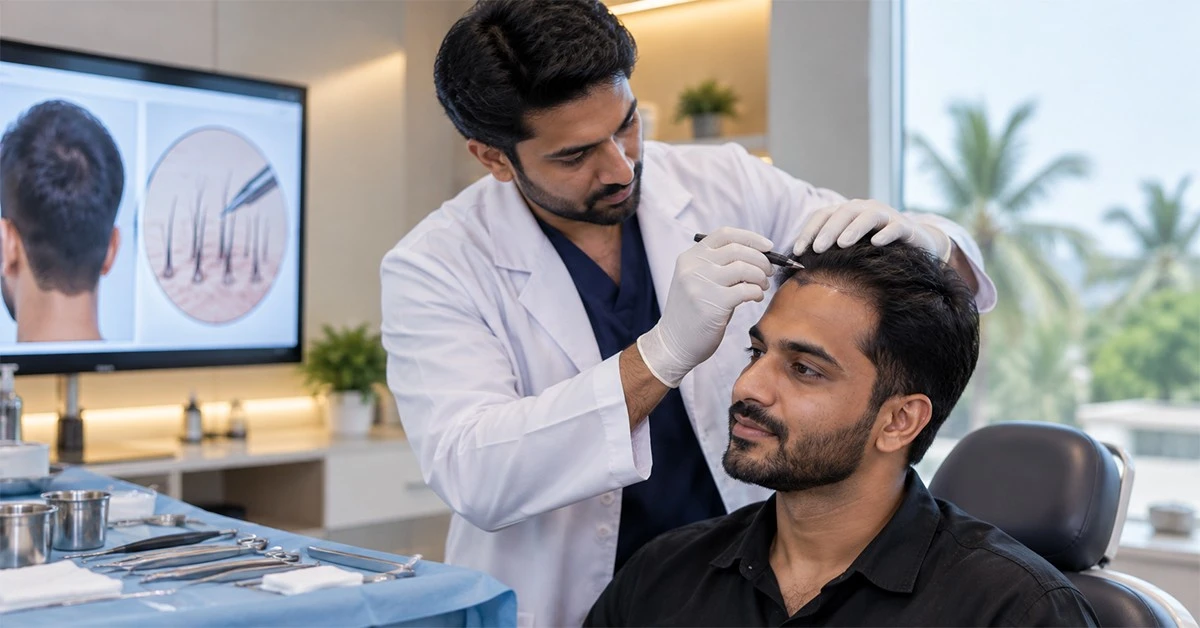
A typical FUE hair transplant procedure involves several stages.
1. Scalp and Hair Assessment
Before treatment, the doctor evaluates the pattern and extent of hair loss, scalp condition, donor density, hair characteristics, and expected progression of hair loss.
The existing hairline and areas requiring additional density are also assessed to develop an appropriate treatment plan.
2. Donor Area Preparation
The donor area is prepared before follicular extraction. Local anaesthesia is generally used to keep the procedure comfortable.
3. Follicular Unit Extraction
Individual follicular units are carefully extracted using a specialised punch instrument. Each unit may contain one or more hair follicles.
The extracted grafts are handled carefully because their viability can influence the success of transplantation.
4. Recipient Area Preparation
The doctor makes small recipient sites in the areas where hair density is to be restored. The angle, direction, and distribution of these sites are important for achieving a natural-looking pattern.
5. Graft Placement
The harvested follicular units are then implanted into the prepared recipient sites. The number of grafts needed will depend on the extent of hair loss, the donor supply, and the goals of the treatment.
Who May Be Suitable for FUE Hair Restoration?
FUE hair restoration may be considered for adults with certain types of permanent hair loss, particularly pattern hair loss.
A suitable candidate generally needs:
- A sufficient donor supply of healthy hair follicles
- A clearly identifiable area requiring restoration
- Good overall scalp health
- A realistic understanding of achievable density
- A reasonably stable or predictable pattern of hair loss
However, suitability cannot be determined from hair loss severity alone. The underlying cause of hair loss should be evaluated before proceeding.
Why Is Donor Hair So Important?
Hair transplantation depends on the patient’s own donor follicles. There is therefore a finite supply of hair available for redistribution.
During FUE hair transplantation planning in Kerala, the doctor may assess donor density, hair calibre, follicular unit characteristics, and the size of the recipient area.
If the donor supply is limited, attempting to cover a large bald area may result in lower density. Careful planning helps preserve donor hair for potential future needs.
Can FUE Treat a Receding Hairline?
FUE may be used to restore or improve a receding hairline in appropriately selected patients.
However, designing the hairline requires consideration of age, facial proportions, existing hair loss, donor availability, and the likelihood of future recession.
Creating an excessively low or dense hairline may use donor follicles that could be needed later. A conservative, age-appropriate design is often important for long-term planning.
For more information about this specific concern, see our guide to hair transplant for a receding hairline.
How Long Does an FUE Hair Transplant Take?
The duration varies depending on the number of grafts being transplanted and the complexity of the procedure.
Smaller procedures may take less time, while larger sessions can require several hours. Your doctor can provide a more accurate estimate after assessing the number of grafts required.
What Is Recovery Like After FUE?
Mild redness, swelling, tenderness, or small crusts may occur during the early recovery period.
The transplanted area requires careful handling while the grafts become established. Your doctor will provide instructions regarding washing, sleeping position, physical activity, and scalp care.
The visible appearance generally changes as healing progresses, so the immediate post-procedure appearance should not be considered the final result.
For a stage-by-stage overview, read our hair transplant recovery timeline.
When Do FUE Hair Transplant Results Appear?
Hair transplantation is not an instant density-restoration procedure.
The transplanted follicles undergo their normal growth cycle. Some transplanted hairs may shed temporarily before new growth begins.
Visible improvement generally develops gradually over several months, with the outcome taking longer as the transplanted hairs mature.
You can also learn more about what happens during the growth phase in our guide to hair growth after a hair transplant.
Is FUE Suitable for Everyone?
No. Follicular unit extraction Kerala procedures are not automatically appropriate for every person experiencing hair loss.
Transplantation may be unsuitable or may need to be delayed when the cause of hair loss has not been established, active scalp conditions are present, donor hair is insufficient, or expectations are unrealistic.
In some cases, medical treatment may be recommended first to stabilise ongoing hair loss.
How Should You Choose an FUE Hair Transplant Clinic?
Choosing a clinic involves more than comparing treatment packages or graft prices. Patients should consider the qualifications and experience of the treating doctor, the clinical facility, consultation process, surgical technique, infection-control practices, and postoperative follow-up.
It is also useful to understand who performs each stage of the procedure, how graft numbers are determined, and how the donor area will be managed over the long term.
Before scheduling a consultation, read our guide on how to choose a hair transplant clinic in Kerala.
Expert Insights
At Medlounges, hair transplantation is approached as an individualised procedure rather than a one-size-fits-all treatment. A detailed assessment of hair-loss pattern, donor availability, scalp health, and long-term expectations helps determine whether FUE is an appropriate option.
Conclusion
FUE Hair Transplant in Kerala may be an option for some people with permanent hair loss, provided there is sufficient donor hair.
The process includes the removal of individual follicular units, preparing the recipient site, and placement of grafts based on the desired hairline and density. Results vary between individuals, so it is best to seek a professional evaluation before deciding on treatment.
The First Step to Your Consultation
If you are considering FUE, a consultation at Medlounges can help assess your hair-loss pattern, donor area, scalp health, and suitability for transplantation before a treatment plan is recommended.
Ready to understand your options? Book your consultation at Medlounges, Kochi / Thiruvalla today.
Medical Disclaimer
Hair transplantation is a medical procedure. Each person may experience different results, risks, outcomes, and recovery. This information is provided for educational purposes only and is not a replacement for professional medical advice.
Frequently Asked Questions
What is FUE hair transplantation?
FUE is a hair transplantation technique in which individual follicular units are extracted from a donor area and transplanted into areas affected by hair loss.
Is FUE suitable for advanced baldness?
It may be considered in selected cases, but the extent of restoration depends heavily on the available donor hair and the size of the area requiring coverage.
Does FUE create new hair follicles?
No. FUE redistributes existing hair follicles from a donor area to areas where additional hair density is needed.
How long does an FUE transplant take to show results?
Hair growth occurs gradually. Initial shedding can occur, followed by new growth over the following months. The final result may take longer to mature.
Is FUE painful?
Local anaesthesia is used during the procedure to minimise discomfort. Some tenderness or sensitivity may occur during the recovery period.