When considering a hair transplant, you may come across different techniques that promise to improve hair density and restore thinning areas. Two terms you may encounter are FUE and GAT, but understanding what actually differs between these approaches is more useful than choosing a technique based on its name alone. For anyone researching FUE vs GAT Hair Transplant, understanding these differences can help provide a clearer picture of what each approach involves.
Both these methods attempt to restore hair with the patient’s own donor follicles. However, the way in which the follicles are harvested, handled, and transplanted can vary according to the technique and the clinical protocol that is being followed.
What Is FUE Hair Transplantation?
FUE, or Follicular Unit Extraction, is a widely used hair transplantation technique.
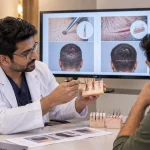
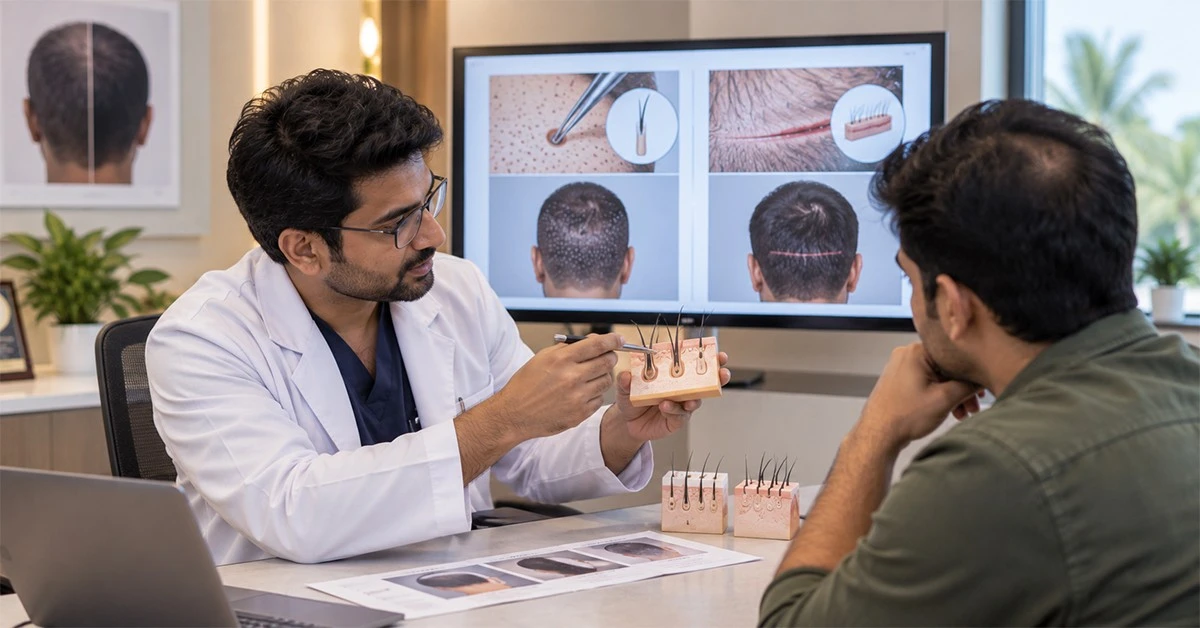
Individual follicular units are extracted from the donor area, usually the back or sides of the scalp. These grafts are then prepared and placed into recipient sites created in areas affected by hair loss.
Because individual grafts are extracted rather than removing a strip of scalp, FUE does not leave the linear scar associated with traditional strip harvesting. However, individual extraction sites can still leave small marks, and their visibility can vary between patients. The NHS also describes FUE as involving individual graft extraction and multiple small scars rather than a single linear scar.
For more information about the procedure, see our guide to FUE hair transplant in Kerala.
What Is GAT Hair Transplantation?
GAT is another term used in some hair-transplant settings to describe an advanced approach to graft extraction and transplantation.
However, GAT hair transplant terminology is not as universally standardised as FUE. The specific instruments, extraction method, graft-handling process, and implantation protocol may differ between clinics.
This is why patients should ask the treating doctor exactly what the GAT technique involves rather than assuming that the term represents one universally defined surgical method.
FUE vs GAT: What Are the Main Differences?
The differences are easier to understand when the individual aspects of the procedures are considered.
Basic Approach
FUE: Individual follicular units are extracted from the donor area and subsequently transplanted into the recipient area.
GAT: The specific extraction and transplantation approach may vary according to the protocol followed by the clinic.
Donor Area
FUE: Hair is generally harvested from suitable areas at the back or sides of the scalp.
GAT: The donor area is selected based on the availability and quality of suitable follicles, while the exact harvesting process depends on the specific protocol.
Linear Strip Removal
FUE: FUE does not involve removing a linear strip of scalp.
GAT: Whether a linear strip is involved depends on the exact procedure being described as GAT. Patients should confirm the harvesting method with the doctor before treatment.
Graft Handling
FUE: Individual follicular units are extracted and carefully prepared before transplantation.
GAT: Graft handling depends on the extraction and implantation protocol being used.
Treatment Planning
Both techniques require careful planning based on the patient’s donor hair supply, degree of hair loss, recipient area, existing density, and long-term restoration goals.
Understanding these factors is also important when deciding whether someone is an appropriate candidate for transplantation. Read more about who is a good candidate for a hair transplant.
Suitability
Neither is necessarily right for all patients. Before recommending treatment, a doctor should consider the person’s pattern of hair loss, scalp condition, donor density and expectations.
A proper consultation can also help determine whether the available donor hair is sufficient for the areas that need restoration.
Does One Technique Give Better Results?
There is no universal answer that one technique will produce better results for every patient.
The quality of a hair transplant depends on several factors, including donor hair characteristics, graft survival, recipient-site design, hairline planning, surgical technique, and appropriate aftercare.
A technically advanced procedure cannot compensate for inadequate donor hair or unrealistic expectations.
The American Academy of Dermatology also notes that hair-transplant outcomes depend substantially on appropriate candidate assessment and the expertise of the doctor performing the procedure.
Which Technique Is Better for You?
The choice between FUE vs GAT should be based on your individual hair-loss pattern and the treatment plan recommended after assessment.
Your doctor might consider:
- The pattern and causes of hair loss
- Quality and density of donor hair
- Number of grafts needed
- Hair caliber and characteristics of the follicular units
- Scalp health
- Earlier hair transplant treatments
- Expected future hair loss
- Desired areas of restoration
In some cases, medical treatment may also be recommended to stabilise ongoing hair loss before transplantation.
If you are comparing clinics and treatment options, you can also read our guide on how to choose a hair transplant clinic in Kerala.
What About Recovery?
Recovery depends on the actual extraction and implantation technique used, as well as the number of grafts transplanted.
After hair transplantation, patients may experience temporary redness, swelling, sensitivity, or crusting around the treated areas.
Following post-procedure instructions is important to protect the transplanted grafts during the early healing period.
The NHS notes that patients need to take particular care of transplanted grafts during the early recovery period, while temporary swelling, scabbing and small scars can occur after hair transplantation.
Does GAT Mean a Completely Scar-Free Procedure?
No hair-transplant technique should automatically be described as completely scar-free.
When individual follicular units are extracted, tiny extraction sites can heal with minimal visible marks in many patients. However, healing varies according to factors such as extraction technique, punch size, skin characteristics, and individual healing response.
It is therefore more accurate to discuss scar characteristics and visibility rather than promise a completely scarless result.
Expert Insights
At Medlounges, hair restoration techniques should be selected based on diagnosis and treatment planning, and not based on the name of a particular procedure. The best approach depends on evaluating donor capacity, hair loss progression, scalp health, and restoration goals.
Patients considering treatment can explore the hair transplantation service at Medlounges to understand the treatment pathway and consultation process.
Conclusion
FUE vs GAT Hair Transplant is not simply a choice between two names. The important considerations are how the grafts are extracted and handled, how the recipient area is planned, and whether the approach suits your individual hair-loss pattern.
A professional assessment can help determine which hair restoration technique is appropriate for your donor supply, degree of hair loss, and long-term goals.
The First Step to Your Consultation
If you are considering hair transplantation, a consultation at Medlounges can help you understand the available techniques and identify the approach most appropriate for your individual needs.
Ready to understand your options? Explore hair transplantation at Medlounges and book a consultation at Medlounges, Kochi / Thiruvalla.
Medical Disclaimer: Hair transplantation is a medical procedure. Various techniques have different considerations regarding suitability, risks, recovery, and results. This material is provided solely for educational purposes and is not a substitute for professional medical advice.
Frequently Asked Questions
Is FUE better than GAT hair transplantation?
There is no one approach that is inherently better than the other for all patients. Eligibility is determined by the patient’s donor supply, pattern of baldness, scalp condition and treatment goals.
What does GAT mean in hair transplantation?
GAT is a term used for certain graft extraction or transplantation protocols. Because the terminology can vary, patients should ask their doctor about the exact technique being offered, including how grafts are extracted, handled and implanted.
Is FUE a permanent hair transplant?
Transplanted follicles are generally selected from areas that are more resistant to pattern hair loss, but future hair loss in untreated areas can still occur. Long-term planning is therefore important.
Which technique has less scarring?
Individual follicular extraction techniques such as FUE do not involve removing a linear strip. The visibility of individual extraction marks varies between patients and depends on the technique used.
How do I choose between FUE and GAT?
A doctor should evaluate your pattern of hair loss, donor density, donor health, graft requirements and long-term expectations before recommending a technique.