There comes a time when many people start to notice subtle changes in their face. The cheeks may appear a bit lower, the jawline less defined, and the corners of the mouth slightly drooped. These changes are gradual and not dramatic, but they become harder to ignore over time.
Read More: Best Chemical Peel for Indian Skin: Which Type Is Right for You?
This is when many adults begin to explore their options—not because they are ready for surgery, but because they want to understand what can be done early on. If this sounds like you, this article will help. Here, you’ll find a simple, medically-based explanation of what a thread lift is and how it works, what the procedure itself involves, who it typically suits, what kind of results you can realistically expect, and what to think about before deciding if it’s a good fit for your care plan
What Exactly Is a Thread Lift?
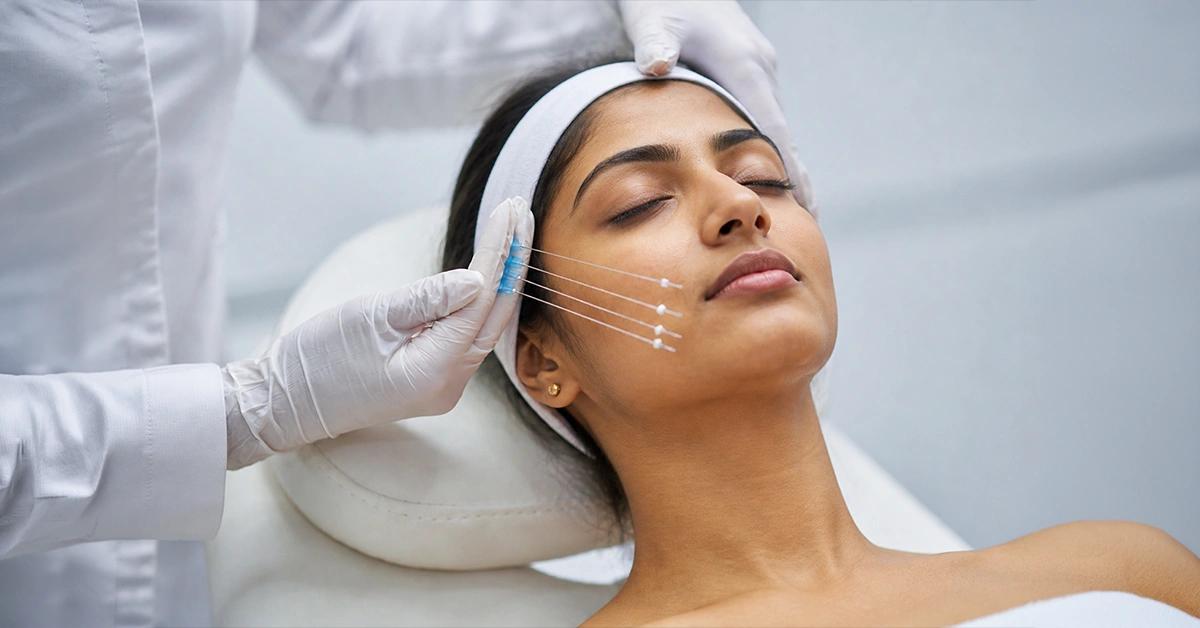
A thread lift is a minimally invasive aesthetic procedure in which an aesthetic physician places fine, dissolvable threads under the surface of the skin to provide structural support and encourage the body’s natural collagen production. Unlike a surgical facelift, which requires incisions, tissue removal and a lengthy recovery, a thread lift works by gently repositioning tissue and stimulating a biological healing response that improves skin firmness over time.
The threads used are usually made from PDO – polydioxanone – a material that has been used safely in medical sutures for decades. Your body thinks it’s a foreign material that’s only there temporarily, and it reacts by creating new collagen around it. Eventually the thread dissolves, normally over several months, but the collagen framework it has stimulated still provides some support. That’s why results from a PDO thread lift procedure tend to grow gradually, rather than being immediately apparent.
How Does Thread Lift Work Under Skin?
To understand how a thread lift works, it helps to know what happens to facial tissue as we age. As you age your skin loses collagen and elastin, the fat pads in your face descend and shrink in volume and the ligaments that support the facial structures weaken over time. The end result is a gradual sagging of tissues that most people associate with an aged look-the softening of contours, the deepening of lines, the loss of definition along the jawline.
Also Read: How Often Should You Get a HydraFacial? A Dermatologist’s Guide
A facial thread lift treatment involves placing specialised threads under the skin to lift sagging areas and encourage collagen production. The threads can help to define the cheeks, jawline and facial contours depending on the concern. The type and placement of threads are selected carefully depending on the patient’s skin and facial structure.
What Does the Procedure Actually Involve?
Thread lift procedure explained in simple terms is more accessible than most people think. This treatment is usually done in a clinic with a local anaesthetic, so the area to be treated is numbed before it starts. Patients are awake throughout and most say it feels like pressure, not pain, once the anaesthetic has taken effect.
The aesthetic doctor inserts the threads under the skin using a fine needle or a cannula. Treatment time can vary from thirty minutes to just over one hour depending on the areas being treated and the number of threads used. Once the threads are in place and anchored, the doctor makes small adjustments to the tissue position and finishes the operation.
It is normal and expected to have some swelling, bruising and temporary tightness after treatment. Most patients find they clear in one to two weeks. In the first few weeks of your recovery period you will be asked to limit strenuous activity, excessive facial movement and certain sleeping positions so that the threads can settle properly. The visible improvement occurs over the next few weeks, as collagen production responds to the threads.
For more details, explore Expert Cosmetics Treatment Services
Who Is a Good Candidate — and Who Is Not?
A skin tightening thread lift usually works best for adults with mild to moderate facial laxity who want subtle structural improvement rather than dramatic transformation. Patients with more significant sagging, very thin skin, or poor tissue quality may find that a thread lift does not deliver the change they are hoping for, and an experienced practitioner will always be honest and say so rather than proceed with a treatment that is unlikely to meet expectations.
Actually, age does matter, but not in the way you might think. Someone in their early 40s with early facial laxity might be a better candidate than someone in their 60s with more advanced tissue descent. Not because of the age itself, but because of how much structural support the threads can realistically give in relation to how much change is present. The only way to know whether a thread lift is right for a given patient is by a full facial evaluation by an aesthetic doctor.
See the full guide: Is It Time to Get Smile Correction Treatment? What You Need To Know? (2026 guide)
Thread lifts are also not a substitute for a surgical facelift. With the right candidate, a non surgical facelift thread lift can produce meaningful improvement, but the results are generally more subtle and will last between one and two years compared to the longer term outcomes associated with surgery. Many patients opt for thread lifts because they are not ready for surgery — and for that group, when properly selected, the results can be genuinely satisfying.
Combining Thread Lifts with Other Treatments
In aesthetic medicine it is usual for thread lifts to be part of a wider treatment plan, not a one-off treatment. Some patients will combine them with Botox treatment for dynamic lines, or with Microneedling to get even skin tone along with a lifted face. Some practitioners combine thread lifting with skin quality treatments such as radiofrequency or medical-grade peels to improve the surface while the threads work on the structural layer underneath.” These combinations are always decided by clinical assessment, not as a standard package but as a personalised plan.
Realistic Expectations and Why They Matter
The first thing to understand before considering a thread lift is that the goal is subtle improvement, not a visible transformation. Experienced aesthetic physicians aim for a look that is a rested, naturally refreshed version of the patient’s own face. The face should still move naturally, expressions should still be real and anyone who knows the patient well should notice that they look well rather than notice that they have had something done.
Over weeks and months, quietly, collagen remodelling, the biological process behind much of the thread lift’s long term benefit, develops. Patients expecting to see their full result straight away after treatment will often be disappointed. Patients who understand the timeline are often very happy to see the gradual improvement.
Conclusion
To start figuring out if this treatment is the right fit for your skin and aesthetic goals, you first need to know what a thread lift is and how it works. The insights through this blog on Thread lift is a clinically guided procedure that is best suited for selected candidates. It works by collagen stimulation and tissue support
As every face and skin concern is different, the decision to undergo a thread lift should always be based on honest medical assessment, realistic expectations and guidance from a qualified aesthetic physician or dermatologist.
The First Step to Your Derma Consultation
A consultation is more than an appointment – it’s a chance to understand your skin better, ask questions and receive tailored advice based on your concerns.
Ready to take that first step? Book your dermatology appointment at Medlounges, Kochi/ Thiruvalla today.
Medical Disclaimer: This article is for informational purposes only and does not constitute medical advice. Readers should consult a qualified aesthetic physician or dermatologist before undergoing any cosmetic or dermatological procedure.
Frequently Asked Questions
What is a thread lift?
A thread lift is a minimally invasive cosmetic procedure that uses dissolvable threads to gently lift and reposition sagging facial tissue. It can improve facial contours and stimulate collagen production, creating a firmer and more refreshed appearance without traditional facelift surgery.
- Uses specially designed absorbable threads.
- Can improve mild to moderate skin laxity.
- Usually involves less downtime than surgical facelift procedures.
How does a thread lift work?
A thread lift works by placing fine threads beneath the skin and positioning them to provide a subtle lifting effect. As the threads gradually dissolve, they can stimulate collagen production around the treated area, helping support skin firmness and texture.
- Threads are inserted through small entry points.
- Provides an immediate lifting effect in suitable patients.
- Collagen stimulation develops gradually after treatment.
Which areas can be treated with a thread lift?
Thread lifts can be used to improve sagging or laxity in selected areas of the face and neck. Common treatment areas include the cheeks, jawline, eyebrows, and lower face, depending on the patient’s anatomy and desired results.
- Can help define the jawline.
- May improve mild cheek or lower-face sagging.
- Treatment areas are selected during consultation.
How long do thread lift results last?
Thread lift results are temporary and vary between individuals. The visible lifting effect may gradually change as the threads dissolve and the skin continues to age. Factors such as skin quality, lifestyle, age, and the type of threads used can influence how long results remain noticeable.
- Results vary by patient.
- Collagen production may continue after treatment.
- Maintenance treatment may be considered when appropriate.
Who is a good candidate for a thread lift?
A good candidate is generally someone with mild to moderate skin laxity who wants subtle facial lifting without undergoing traditional surgery. A qualified aesthetic doctor should assess skin quality, facial structure, medical history, and treatment expectations before recommending a thread lift.
- Best suited for selected cases of early skin laxity.
- Realistic expectations are important.
- A consultation is necessary to determine suitability.