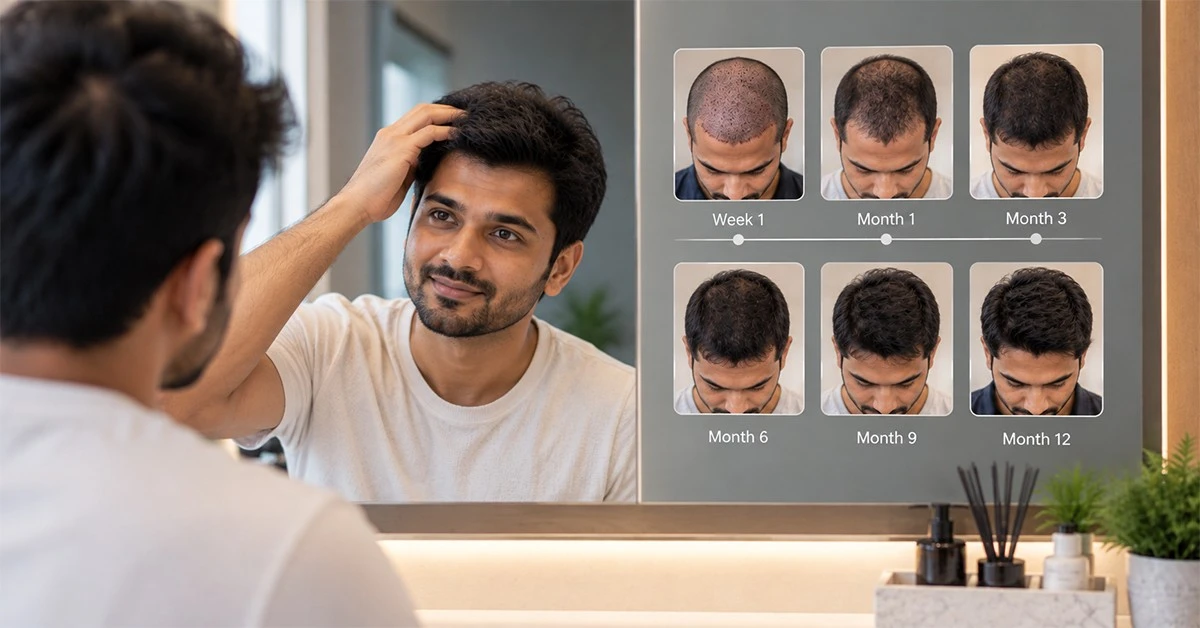
When does hair grow after a hair transplant? It is one of the first questions patients ask before undergoing hair restoration. The important thing to understand is that transplanted hair does not begin growing immediately after the procedure. The follicles need time to heal, enter their natural growth cycle, and gradually produce new strands.
This means the appearance of the scalp can change significantly during the first year. Understanding the hair transplant results timeline can help patients set realistic expectations about shedding, new growth, increasing density and final maturation.
This article explains the typical hair growth timeline after a hair transplant, what happens to transplanted follicles at each stage, and what patients can expect from hair growth after FUE at Medlounges.
Hair Growth Does Not Start Immediately
The first thing patients should understand about transplanted hair growth is that the visible hair placed during transplantation is not the same as immediate permanent growth.
The transplanted follicles need time to settle into their new location. You may lose the visible hair strand in the first few months, but the follicle can remain under the skin. This is why a hair transplant should be evaluated over months rather than weeks.
If you are considering treatment, understanding the procedure itself can also help you prepare for the recovery and growth stages. You can learn more about hair transplantation at Medlounges.
At Medlounges, patients are informed about this growth cycle before treatment so that expectations are based on the biological process of hair growth rather than immediate visual changes.
The First Few Weeks: Healing and Early Changes
During the first few weeks, the focus is primarily on healing rather than new hair growth.
Patients may see short hairs around the transplanted grafts along with small scabs or redness. These are part of the early postoperative stage.
As the scalp heals, the visible transplanted hairs may begin to shed. This can make the recipient area appear less dense than it did immediately after the procedure.
The change can be surprising, but temporary shedding can occur as the follicles transition into a new growth cycle.
Patients should carefully follow their medical team’s instructions during this period to protect the transplanted grafts.
Months 1–3: The Resting Phase
The first 1–3 months can be the hardest stage emotionally, as you might not be able to see much progress.
The transplanted follicles may be lying dormant under the scalp with little obvious new growth. Patients who expect to see continual improvement may become impatient at this stage.
However, hair follicles operate according to their own growth cycles. A lack of dramatic visible change during this period does not necessarily indicate that the transplant has not worked.
This is why the hair transplant results timeline should always be viewed over the longer term.
For more information about who may be suitable for transplantation, read our guide on who is a good candidate for a hair transplant.
Months 3–4: Early New Growth
After the third or fourth month, patients may start to see new hair growing in the areas of the transplant. These hairs may be fine, soft, or lighter in colour initially.
Growth can be patchy, as not all follicles enter the growth phase at the same time.
The early hairs may not look like the eventual transplanted hair, either in thickness or texture. They need extra time to mature.
Therefore, patients should concentrate on the direction of progress rather than immediate density.
The NHS also explains that transplanted hair may fall out after the first few weeks before new growth starts, with new hair usually beginning to appear around four months.
Months 4–6: Visible Progress
Between approximately four and six months, new growth can become increasingly noticeable.
The transplanted hairs continue to emerge, and the overall appearance of the recipient area may begin to improve. However, the hair can still appear thinner than the final expected result.
The growth rate varies between individuals. Some patients may see significant visible changes earlier, while others develop more gradually.
At Medlounges, progress is considered in the context of the individual patient rather than against a rigid timeline.
For patients specifically considering FUE, our guide to FUE hair transplant in Kerala explains how the procedure works and what patients may expect.
Months 6–9: Density Starts to Improve
Hair growth after FUE becomes more noticeable for many patients during the later part of the first year.
New hairs continue to emerge, while existing transplanted hairs gradually become thicker and more mature. The overall coverage and density can therefore improve significantly compared with the early months.
This is also when patients may begin to appreciate how the transplanted hair is integrating with their existing hair.
However, the process is continuing, and the final result should not necessarily be judged at this stage.
Months 9–12 and Beyond: Maturation of the Result
By around nine to twelve months, many patients can see a much clearer picture of their transplant outcome.
The transplanted hairs continue to mature in thickness, texture, and overall appearance. Further changes can continue beyond the first year depending on the individual.
The final result is therefore not simply about how many hairs have appeared. It is also about how naturally the transplanted hair blends with the existing hair and how the overall hairline and density develop.
The NHS notes that the full result of a hair transplant can take approximately 10–18 months to become visible.
Why Does Hair Grow at Different Speeds?
Patients often compare their progress with friends, online photographs, or other transplant patients. However, hair growth does not follow exactly the same schedule for everyone.
Differences in follicular growth cycles, donor characteristics, treatment area, individual healing, and other biological factors can influence how quickly visible growth develops.
This is why a patient who sees noticeable growth at four months should not automatically be considered a benchmark for someone who sees it later.
A realistic hair transplant growth timeline should allow for individual variation.
Does Aftercare Affect Hair Growth?
Hair transplant aftercare is an important part of the recovery process, particularly during the early healing period.
Patients should follow the postoperative instructions provided by their medical team regarding scalp washing, physical activity, sun exposure, hair products, and care of the transplanted area.
Good aftercare helps protect the grafts during the healing period, but it is important to understand that it cannot force follicles to grow faster than their natural biological cycle.
Patience remains an essential part of the process.
How Medlounges Guides Patients Through the Growth Process
At Medlounges, patients are informed about the expected stages of transplanted hair growth before undergoing the procedure.
The patient’s hair loss pattern, donor area, treatment goals, and realistic expectations are discussed during the consultation. After the procedure, patients are given appropriate postoperative instructions and follow-up.
For patients researching treatment options, our guide on hair transplant in Kerala provides additional information about candidacy, the procedure, recovery and expected results.
This allows the clinical team to monitor recovery and helps patients understand the difference between normal temporary changes and concerns that require professional assessment.
The goal is not to guarantee the same timeline for all patients, but rather to set realistic expectations according to the particular treatment.
Expert Insights
A hair transplant is a long-term restoration process, not an immediate cosmetic transformation.
The early stage is dominated by healing and shedding. The following months involve follicular rest and gradual emergence of new hairs. Density and hair quality then continue to improve as the transplanted hairs mature.
For this reason, patients should assess their results progressively rather than judging the procedure during the first few weeks or months.
At Medlounges, the focus is on setting realistic expectations from the beginning and supporting patients throughout the recovery and growth journey.
Conclusion
When does hair start to grow after a hair transplant? The answer is not instantaneous but gradual. The first few weeks are about healing, the early months can include shedding and follicular rest, and visible new growth usually comes in gradually over the next few months.
Medlounges guides patients through the entire hair transplant results timeline so they know what to expect at each stage. The emphasis is on realistic expectations, proper aftercare, and monitoring progress on the path to restoration.
For patients considering FUE, understanding the natural growth cycle can make the process much easier to approach with patience and confidence.
The First Step to Your Consultation
Thinking about a hair transplant but unsure what kind of growth to expect? A consultation at Medlounges allows your hair loss pattern, donor area, goals, and suitability for transplantation to be assessed before treatment is planned.
You can also learn more about how to choose a hair transplant clinic in Kerala before scheduling your consultation.
Book your hair transplantation consultation with Medlounges in Kochi/Thiruvalla and begin your hair restoration journey.
Medical Disclaimer
This article is solely for informational purposes and is not medical advice. Hair transplant suitability, hair growth, recovery, and results can vary between individuals. Readers are encouraged to consult a qualified medical professional before undergoing a hair transplant procedure.
Frequently Asked Questions
When does hair start growing after a hair transplant?
Generally, you will start to see new growth a little at a time after the first shedding and resting periods. Many patients begin to see new hair growth around the third or fourth month, but the timing may vary.
When will I see the final hair transplant result?
A significant portion of the result may become visible during the first year, but maturation can continue beyond twelve months depending on the individual. The NHS states that full results can take around 10–18 months.
Does transplanted hair shed after the procedure?
Yes, there can be temporary loss of the visible transplanted hair in the first few months. The follicle can stay intact under the skin and then create new growth.
Why is my hair not growing three months after a transplant?
The first few months can be a resting phase for transplanted follicles. Limited visible growth during this period does not necessarily indicate a problem.
Is hair growth after FUE permanent?
Transplanted follicles are generally selected from areas that are less susceptible to pattern hair loss, but individual outcomes vary. Your surgeon can explain the expected longevity based on your specific case.
Will all transplanted hairs grow at the same time?
No. Individual follicles can enter their growth phase at different times, so growth may appear uneven during the early stages.
Can I make transplanted hair grow faster?
There is no reliable way to guarantee faster growth than the follicle’s natural cycle. Following postoperative instructions and maintaining appropriate scalp care supports the recovery process.
Why does transplanted hair initially look thin?
New hairs may be fine at first and become thicker as they mature. Density therefore keeps improving with time.